

Of the hundreds of letters received from the fans of the rock & roll and heavy metal show Andrei produced for the Voice of America, only 175 letters are still kept in the archive.
Starting on December 23, 1989, the young listeners, no longer fearing the consequences of censorship, sent an avalanche of letters: one-page letters, several-page letters, and even one 18-page letter! The paper of the letters seems to have been torn from school notebooks, or it is slightly colored to stand out, or it is a sheer page so that, wrote the sender, the envelope would not weigh too much. Obviously, the writers’ handwriting is diverse: we read the carefully written words of the 12, 13, 14-year old, the rushed handwriting of the 16, 17, 18, 19-year old, and the steady calligraphy of the college students.
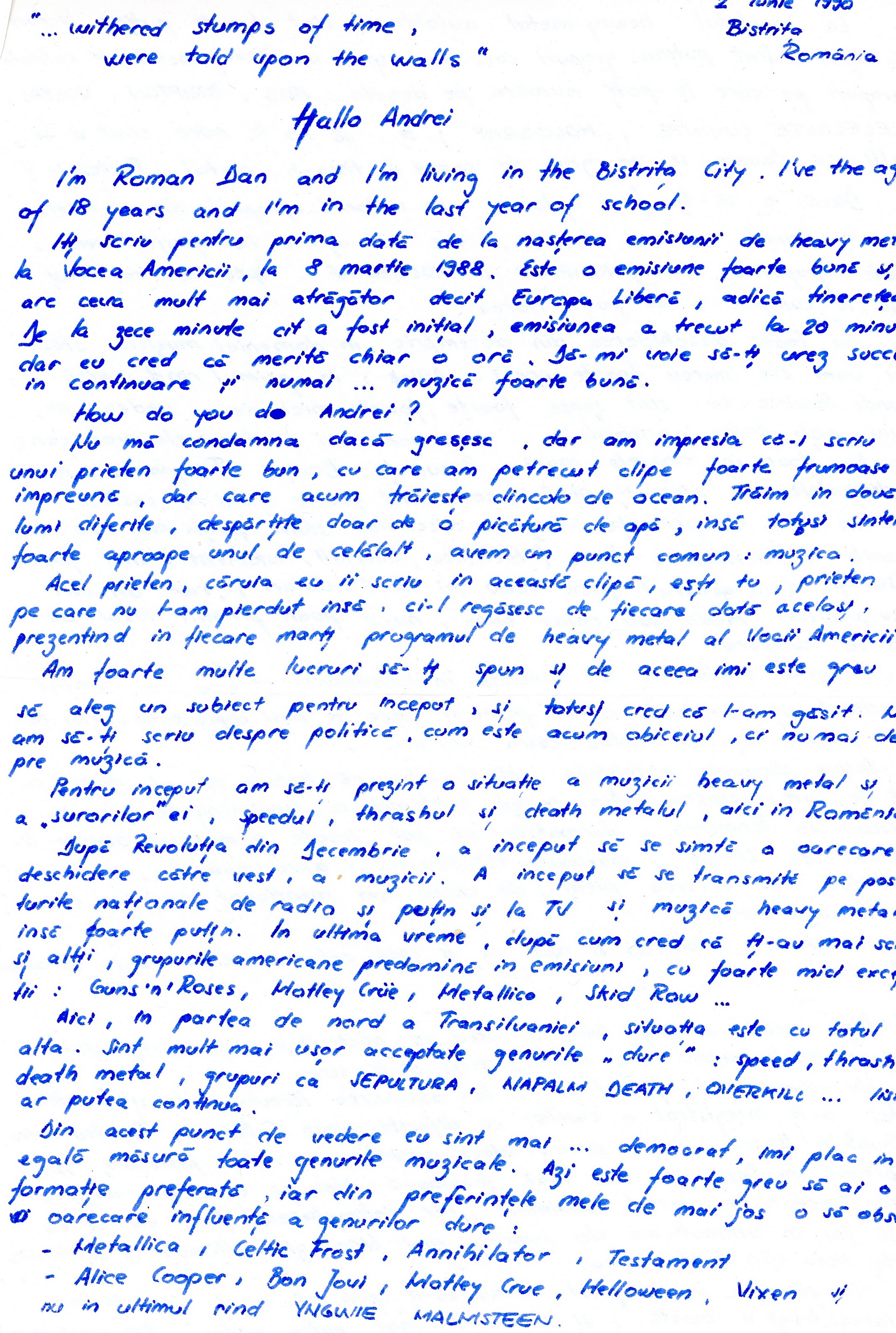
All the letters breathe enthusiasm, sincerity, and warmth and express the senders’ desire to communicate with Andrei – their friend from across the ocean. In his letter of June 2, 1990, Dan from Bistrița confessed he thought he “[was] writing to a very good friend with whom I spent wonderful moments, but who lives across the ocean now. We live in two different worlds and it’s just a drop of water that separates us; we are still very close to each other because we share the same love for music. That friend I’m writing to right now is you, the friend I never lost and is the same every Tuesday when he broadcasts VOA’s heavy metal show.”
The letters sent between March 1988 and December 1989 [not too many] express the writers’ surprise to hear a teenager’s voice inviting his listeners to 20 minutes of rock & roll and heavy metal.
Starting on December 23, 1989, the young listeners, no longer fearing the consequences of censorship, sent an avalanche of letters: one-page letters, several-page letters, and even one 18-page letter! The paper of the letters seems to have been torn from school notebooks, or it is slightly colored to stand out, or it is a sheer page so that, wrote the sender, the envelope would not weigh too much. Obviously, the writers’ handwriting is diverse: we read the carefully written words of the 12, 13, 14-year old, the rushed handwriting of the 16, 17, 18, 19-year old, and the steady calligraphy of the college students.
All the letters breathe enthusiasm, sincerity, and warmth and express the senders’ desire to communicate with Andrei – their friend from across the ocean. In his letter of June 2, 1990, Dan from Bistrița confessed he thought he “[was] writing to a very good friend with whom I spent wonderful moments, but who lives across the ocean now. We live in two different worlds and it’s just a drop of water that separates us; we are still very close to each other because we share the same love for music. That friend I’m writing to right now is you, the friend I never lost and is the same every Tuesday when he broadcasts VOA’s heavy metal show.”
The letters sent between March 1988 and December 1989 [not too many] express the writers’ surprise to hear a teenager’s voice inviting his listeners to 20 minutes of rock & roll and heavy metal.
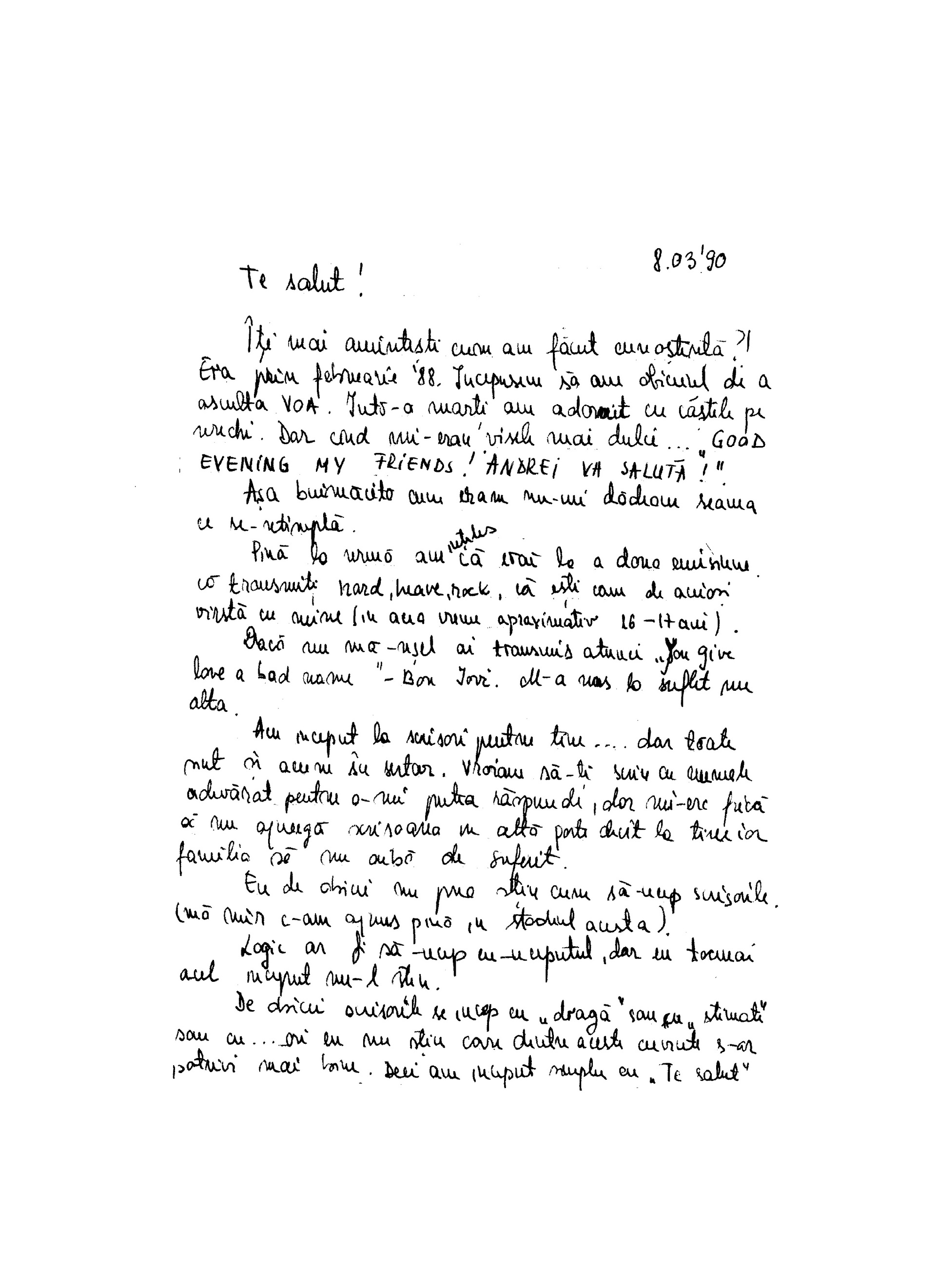
In March 1990, Claudia, from Deva, remembered how she found the rock and heavy metal show by sheer chance, “I think it was February 1988 when I started to listen to the VOA programs. One Tuesday night, I fell asleep with my headsets on. I was already dreaming when, all of a sudden, I hear, ’GOOD EVENING MY FRIENDS, ANDREI SAYS HI!’ I was so confused; I couldn’t figure out what was happening. Finally, I realized you were broadcasting your second show of heavy rock and we are about the same age (16-17). I think you played Bon Jovi’s You Give Love a Bad Name. So sweet! Just what I needed!”
In the late 1980s, Western media reports talked about the youth in East and Central European countries who, with their portable radios and despite jamming, were listening to the Voice of America and Radio Free Europe. Rock and roll had become “a force that inspired the youth and worried the communist authorities.” In Romania, the communist regime’s austerity program would shut down the rock stage of the local bands. Starting in March 1988, VOA’s weekly rock & roll and heavy metal show built a growing listenership among the youth. The fan letters are testimony of the strong impact of those radio shows.
In the late 1980s, Western media reports talked about the youth in East and Central European countries who, with their portable radios and despite jamming, were listening to the Voice of America and Radio Free Europe. Rock and roll had become “a force that inspired the youth and worried the communist authorities.” In Romania, the communist regime’s austerity program would shut down the rock stage of the local bands. Starting in March 1988, VOA’s weekly rock & roll and heavy metal show built a growing listenership among the youth. The fan letters are testimony of the strong impact of those radio shows.
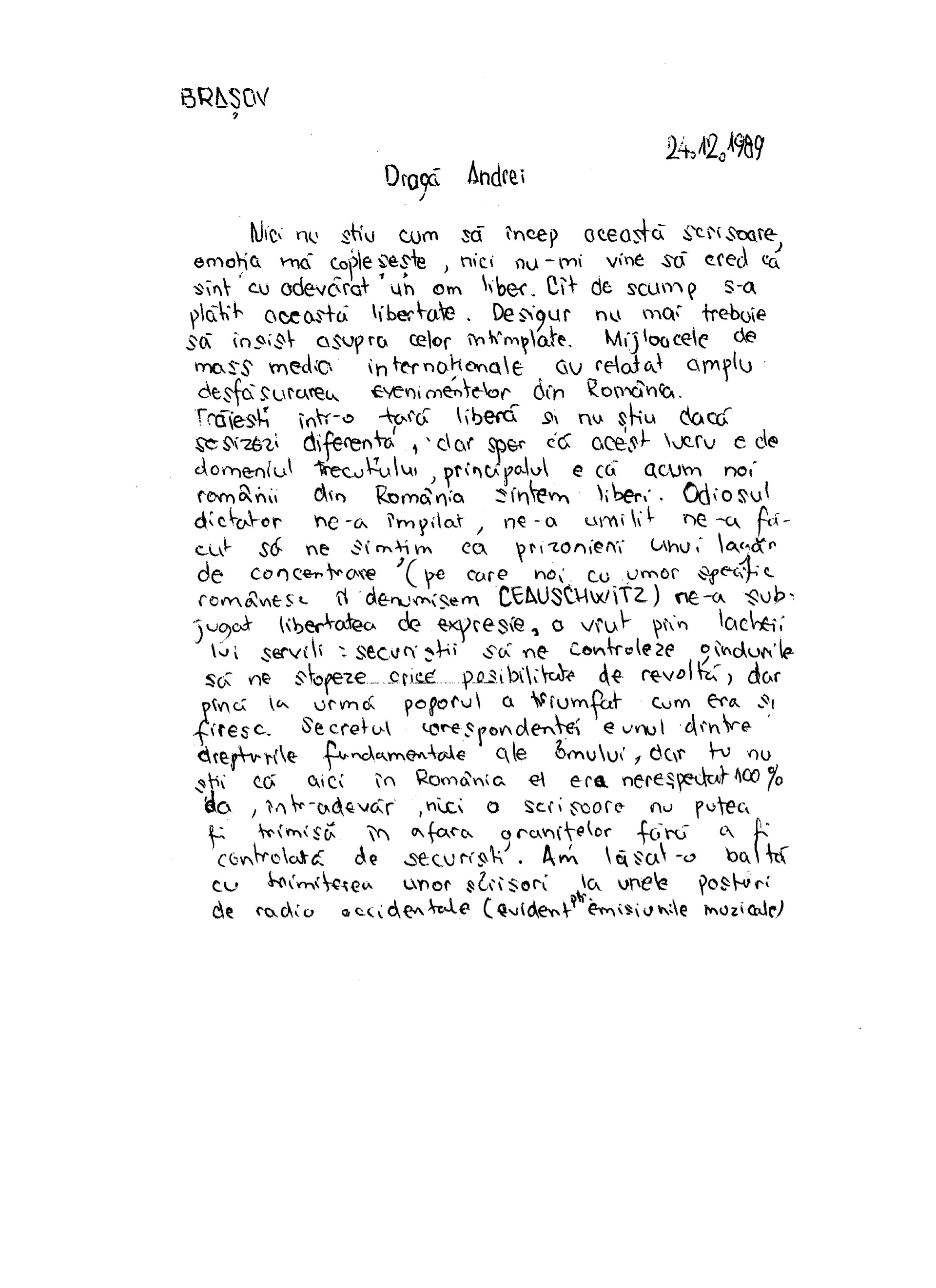
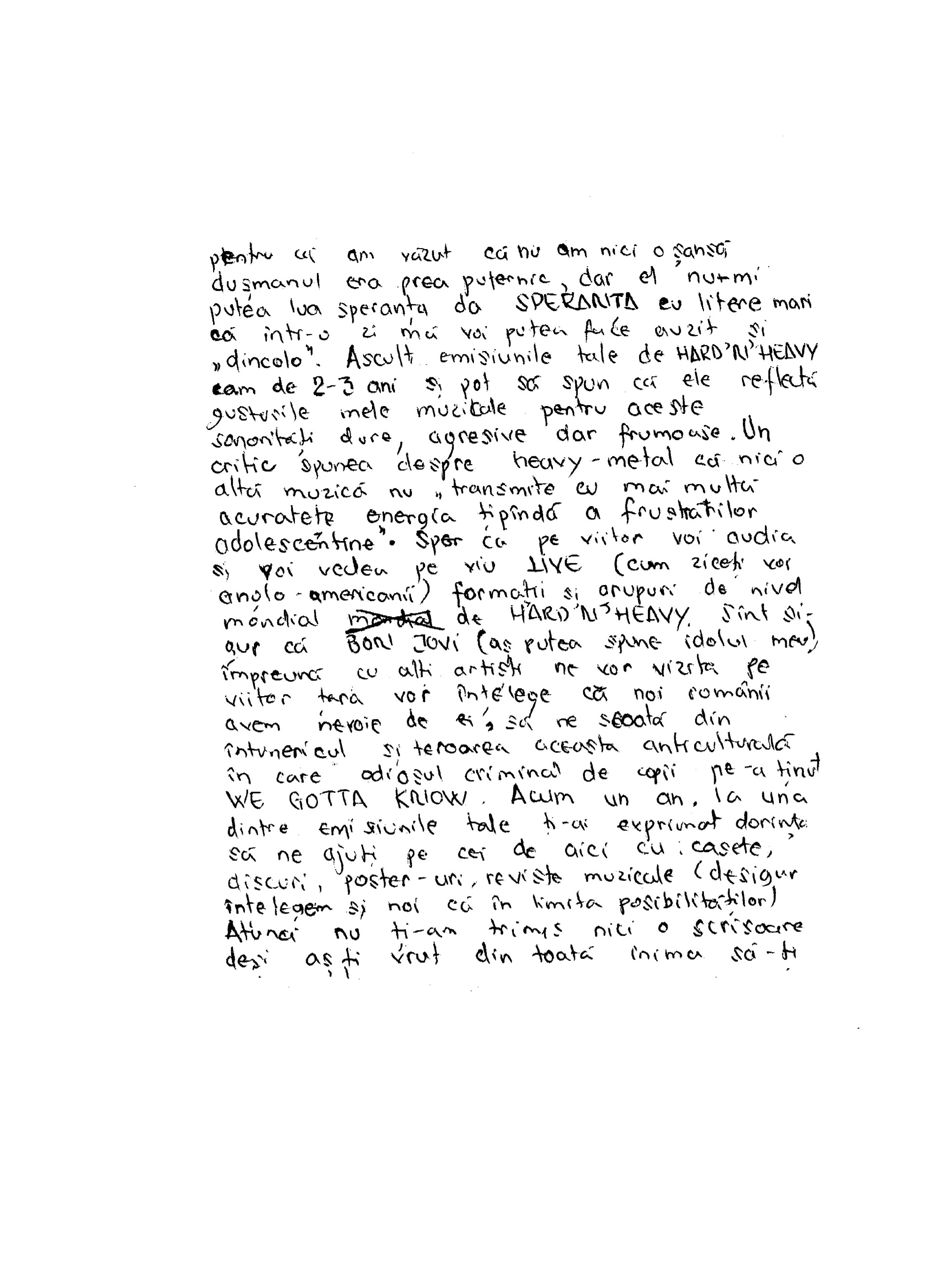
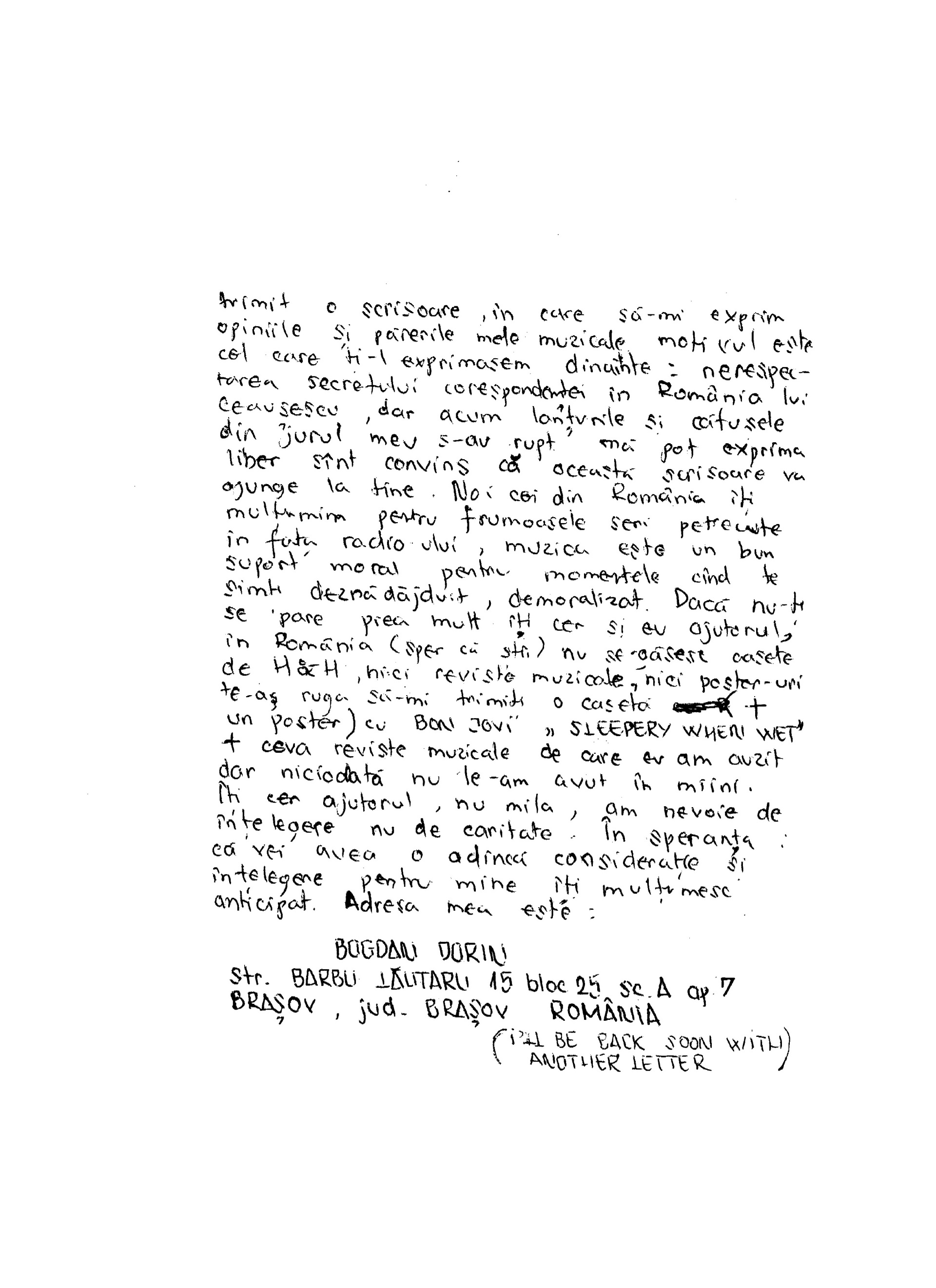
On Christmas Day, December 24, 1989, Dorin from Brașov, “a listener from free Romania, wrote, ”I don’t even know how to start this letter, I’m overwhelmed with emotion, I can’t believe I’m actually free. This freedom came with such a steep price…now the chains and handcuffs around me are broken, I can speak freely; I know for sure this letter will reach you. All of us in Romania thank you for the great evenings we spent together, listening to the radio. Music is such a strong moral support when you are down and disappointed.”
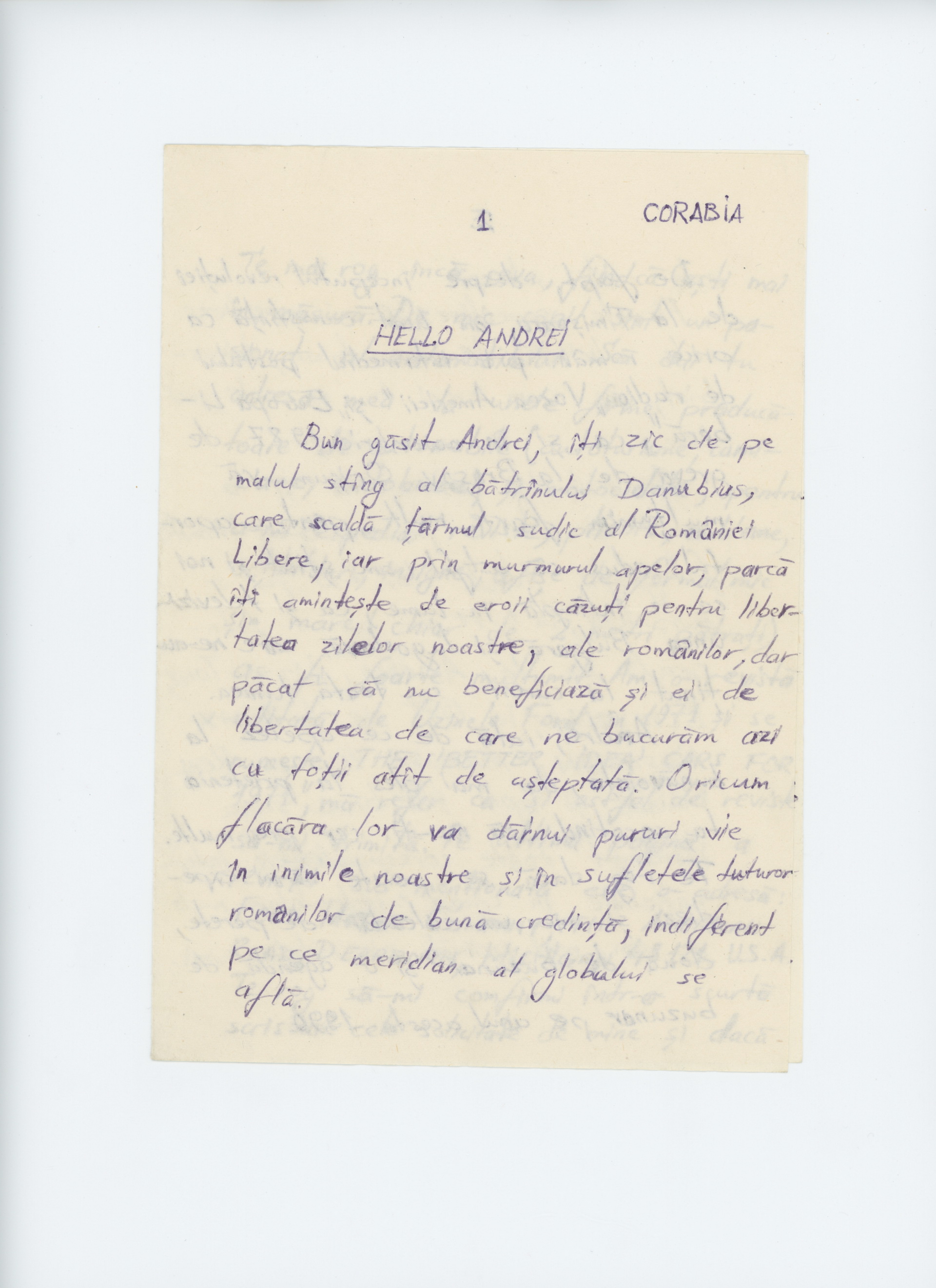
In early 1990, when the echoes of the Revolution were still strong, the young fans, “rockers” and “die-hard metalists,” wrote emotional lines about the events in Romania. Here is what Napoleon from Corabia wrote: “Hello, Andrei. My message comes from the left edge of the old Danubius that is washing the southern shore of free Romania; the water humming reminds us of the heroes who gave their life for the freedom we enjoy today, the freedom of all Romanians. Those heroes are not with us anymore, but the flame of their lives will be forever alive in our hearts and in the souls of all Romanians of goodwill, wherever they are in the world.”
In early 1990, when the echoes of the Revolution were still strong, the young fans, “rockers” and “die-hard metalists,” wrote emotional lines about the events in Romania. Here is what Napoleon from Corabia wrote: “Hello, Andrei. My message comes from the left edge of the old Danubius that is washing the southern shore of free Romania; the water humming reminds us of the heroes who gave their life for the freedom we enjoy today, the freedom of all Romanians. Those heroes are not with us anymore, but the flame of their lives will be forever alive in our hearts and in the souls of all Romanians of goodwill, wherever they are in the world.”
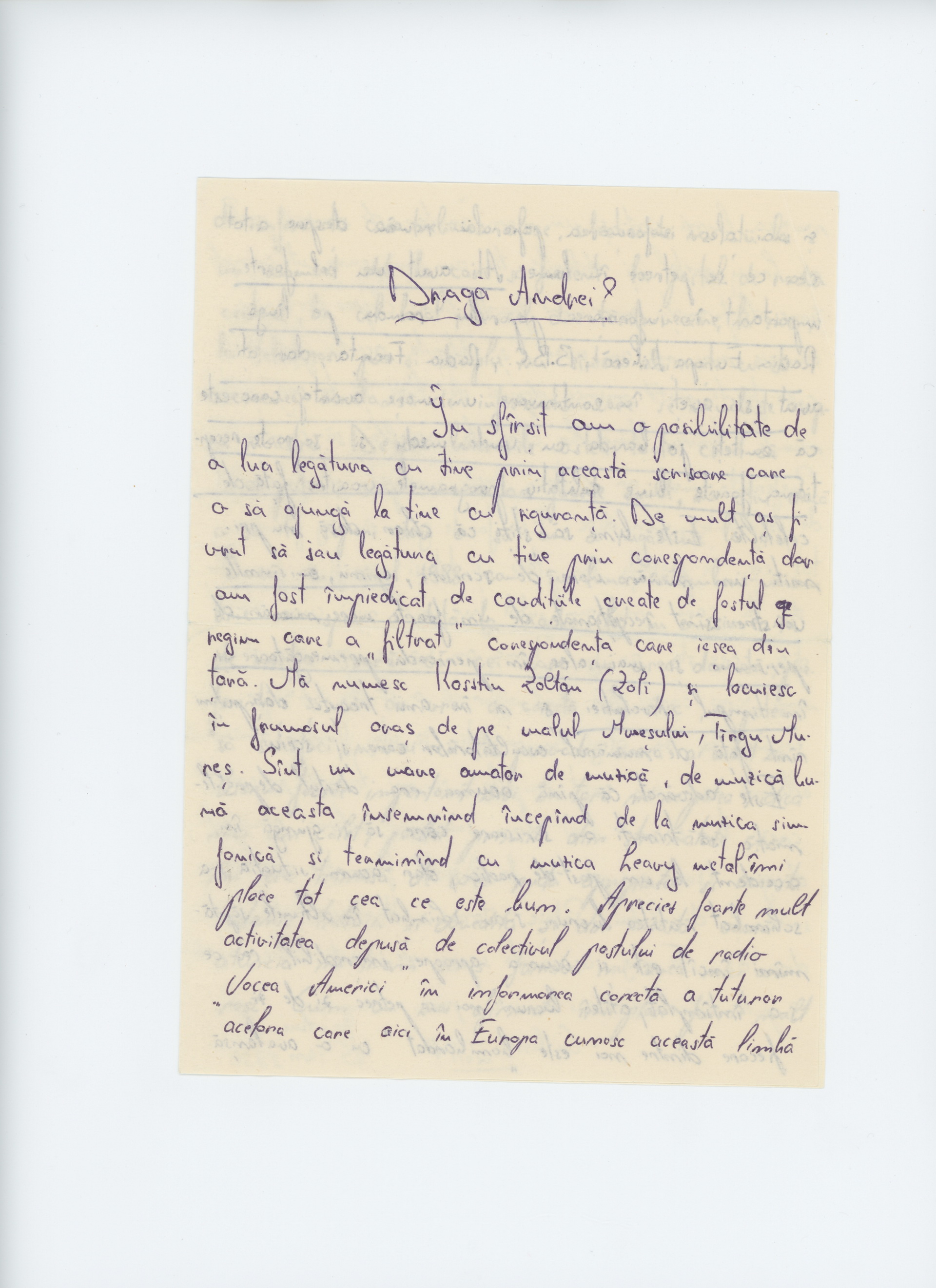
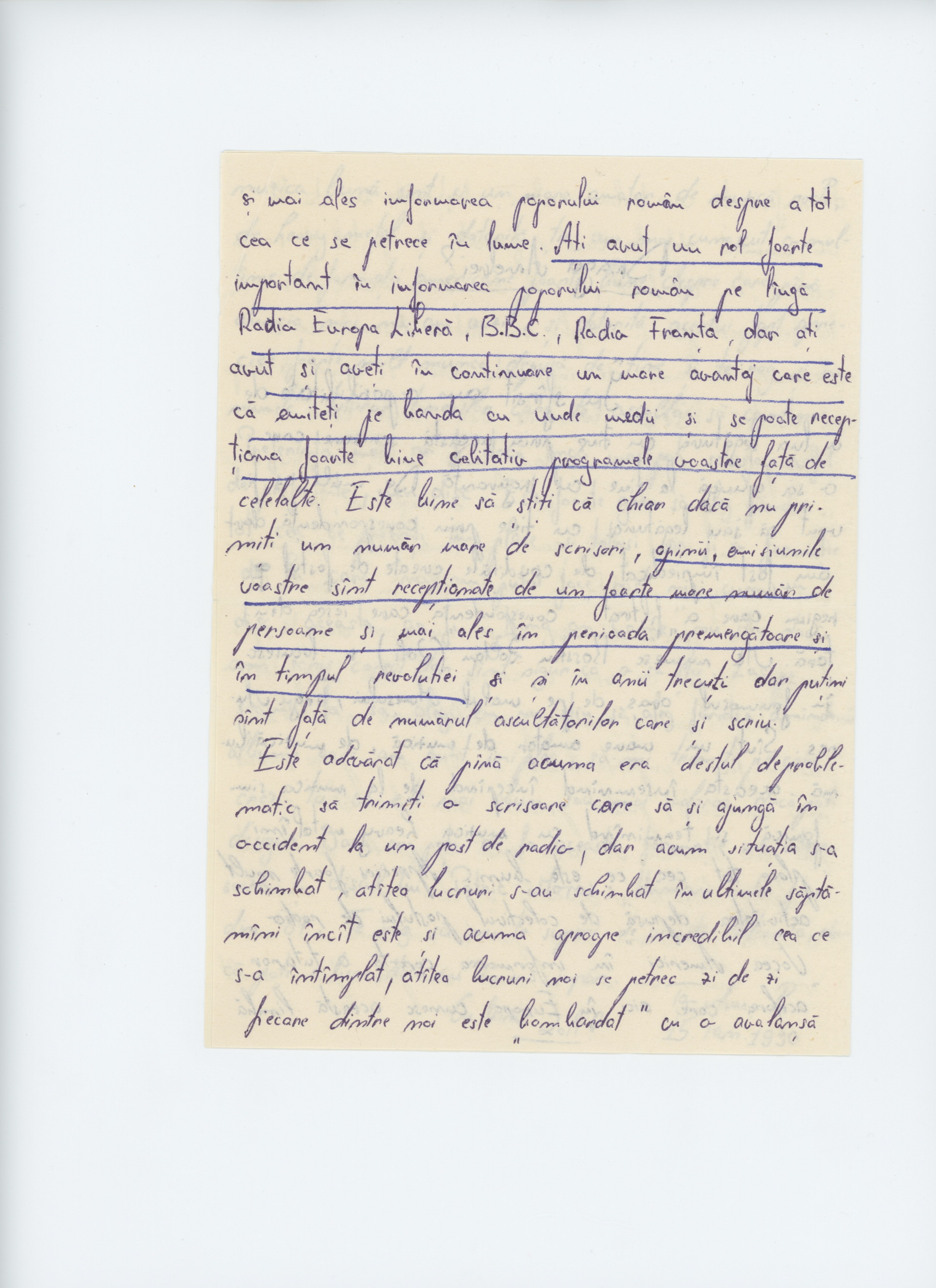
In 1990, Zoli, a listener from Târgu Mureș, wrote that VOA programs, along with RFE, BBC, and Radio France, “played a very important role in keeping the Romanian people informed. You should know that, even if you may not receive too many letters and messages, very many people listened to the VOA broadcasts, especially before and during the Revolution.”
In March 1990, King Lawrence from Bucharest, used similar words in his letter that started with a boisterous greeting, “Rock is our religion and in rock we trust! Hello, hello, hello Dear Friend Andrew! A warm welcome greeting from a fan of good music and a metallic handshake of one of the faithful listeners of your shows. First, I’d like to extend my thanks to you who, together with the rock & roll shows of RFE’s Radu Theodor, were the only sources of information for news about the rock & roll in the Western world, true miracles for us when we were lost, buried under oppressive darkness of the curse of communism. I am 18, one year younger than you.”
In March 1990, King Lawrence from Bucharest, used similar words in his letter that started with a boisterous greeting, “Rock is our religion and in rock we trust! Hello, hello, hello Dear Friend Andrew! A warm welcome greeting from a fan of good music and a metallic handshake of one of the faithful listeners of your shows. First, I’d like to extend my thanks to you who, together with the rock & roll shows of RFE’s Radu Theodor, were the only sources of information for news about the rock & roll in the Western world, true miracles for us when we were lost, buried under oppressive darkness of the curse of communism. I am 18, one year younger than you.”
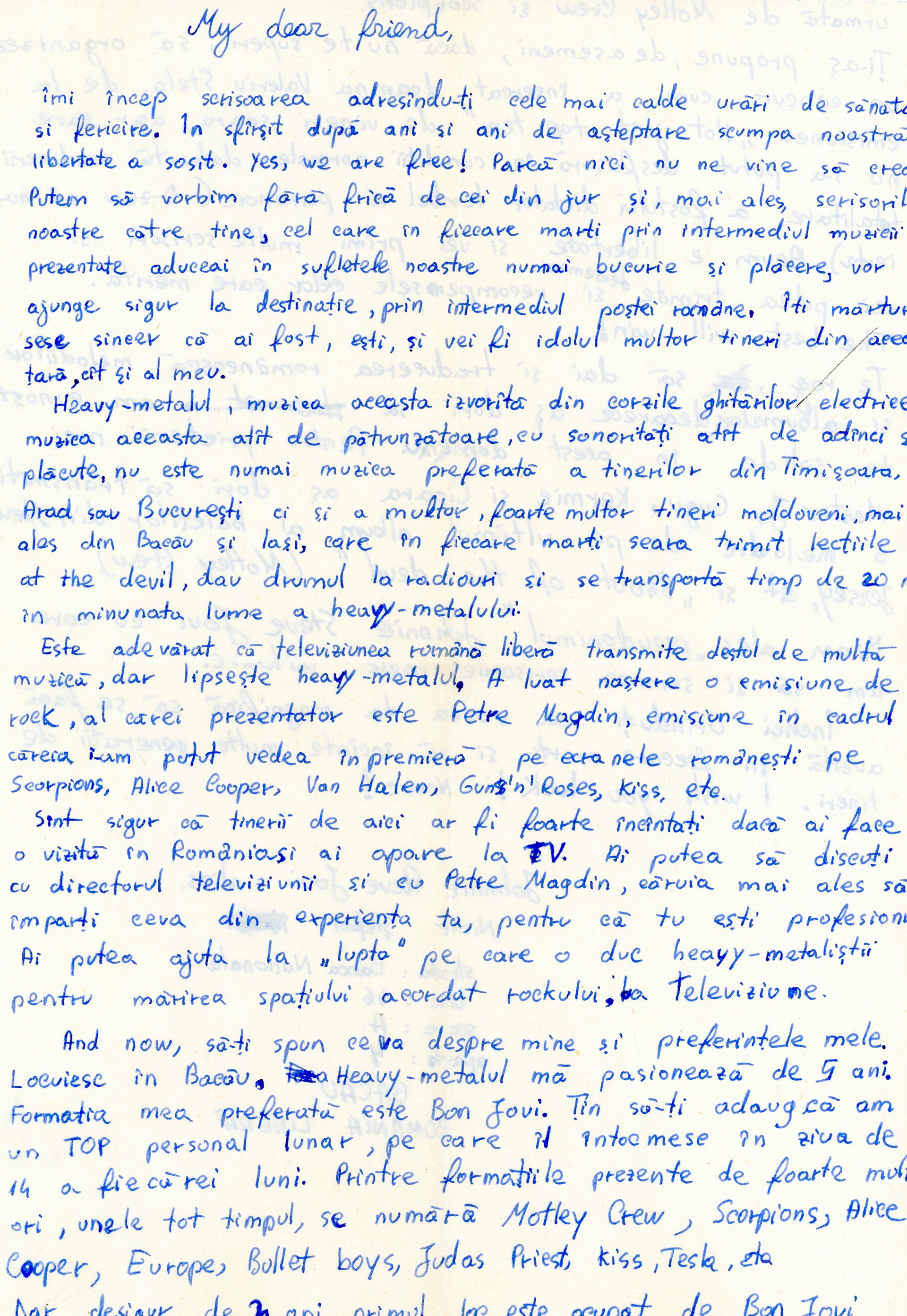
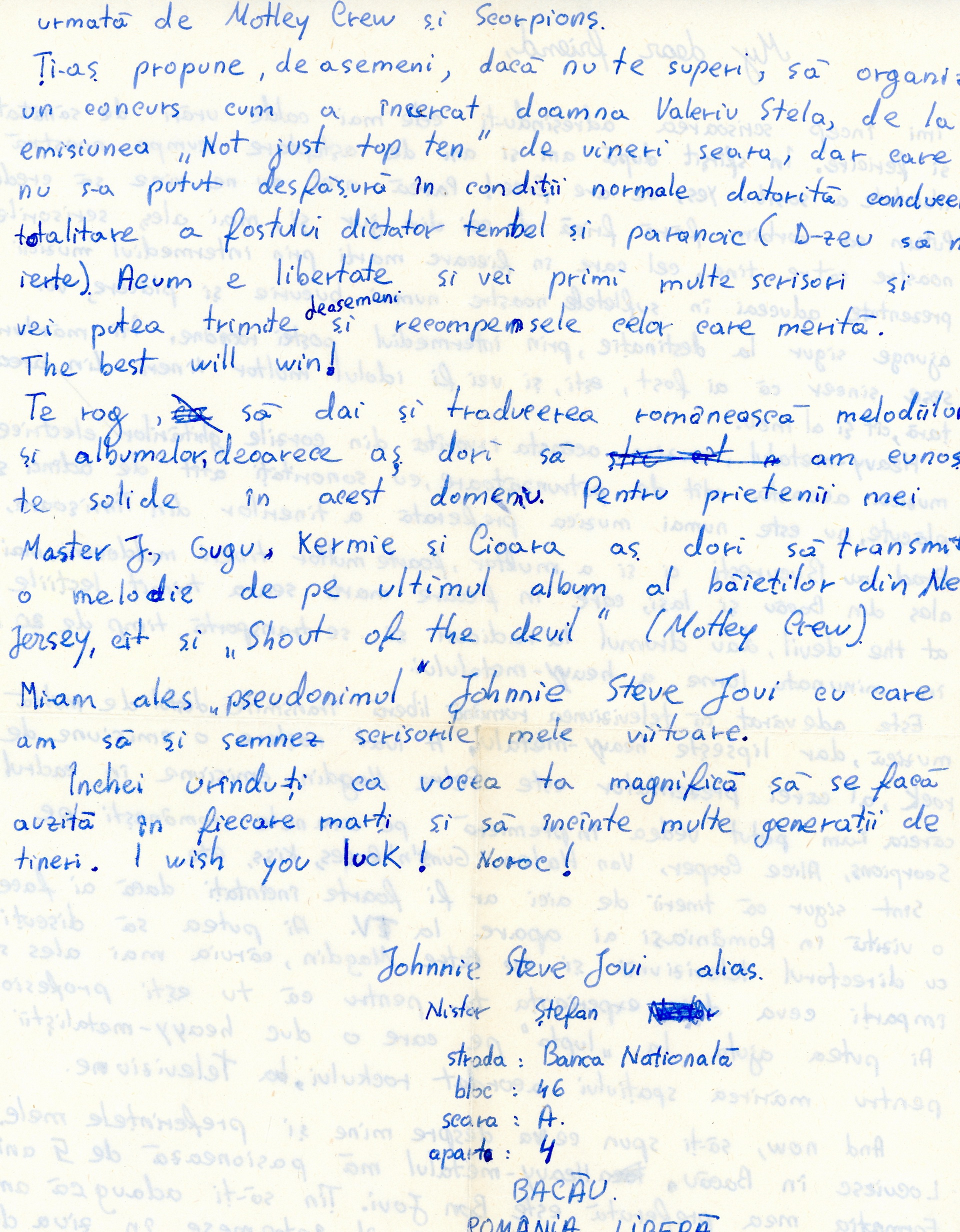
Stefan, from Bacău, a.k.a. Johnie Steve Jovi, sent his letter from “Free Romania” with the words, “finally, after waiting for years, our sweet freedom is here. Yes, we are free! It’s hard to believe. We can talk without looking around for fear somebody will turn us in and, most importantly, our letters for you, who, every Tuesday, brought joy and excitement to our souls, will certainly reach you, via the Romanian mail service. I have to tell you that you have been and will be an idol for many youth Romanians and my idol as well.”
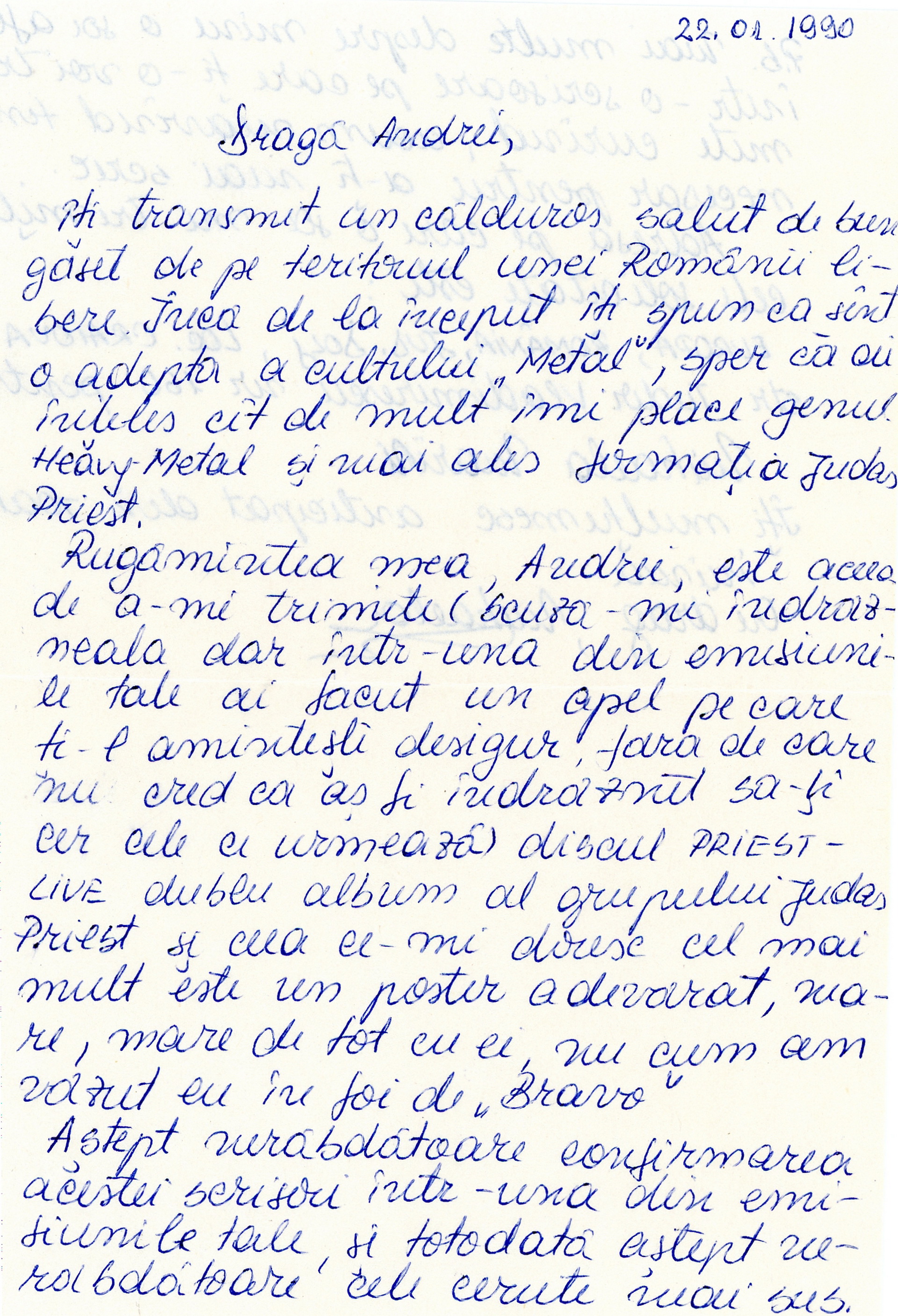
On January 22, 1990, Mihaela from Craiova sent Andrei “warm greetings from free Romania!”
On January 22, 1990, Mihaela from Craiova sent Andrei “warm greetings from free Romania!”
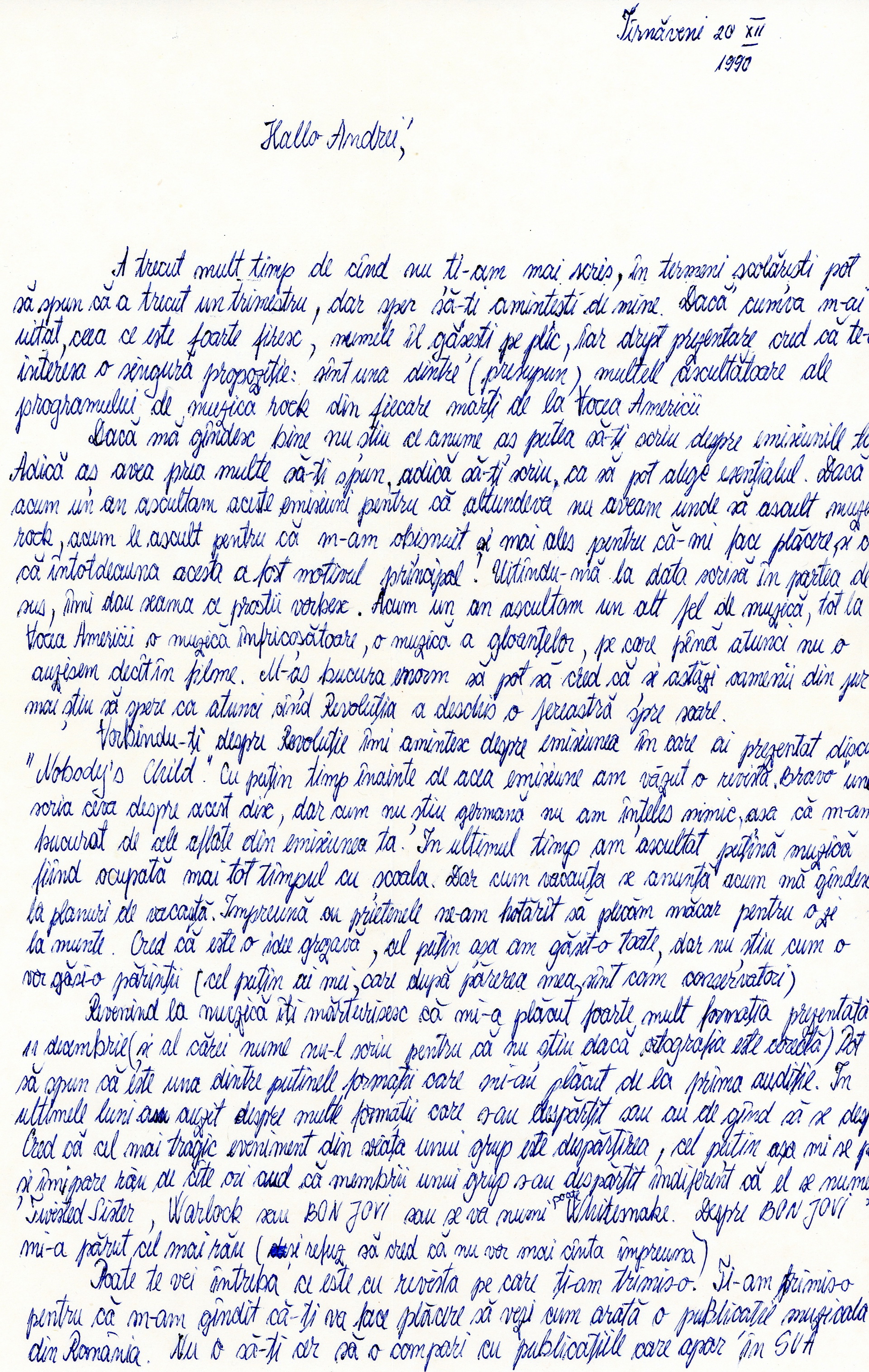
Almost one year after the Revolution, Ioana from Târnăveni wrote that, “a year ago we were listening on the VOA to a different type of music, a frightful music, a music of the bullets we had heard only in the movies. I’d like to believe that, today, the people around me are still as hopeful as they were when the Revolution opened a window towards the sun.”
It is quite difficult to choose the most resonant passages from the letters sent by the young listeners three decades ago. Each line makes you read further, to get acquainted with the sender, and to learn more about those who listened to Andrei’s show and opened their hearts to their friend across the ocean. We are looking at an asynchronous correspondence since Andrei could not send prompt responses to the letters, and the requests for cassettes, records, posters, banners, journals, guitars, drums, broadcasting equipment, post cards, blue-jeans, and sneakers could not be met by VOA’s intern DJ. We do hope, however, that, with their youthful generosity and enthusiasm, the listeners did not bear a grudge against their friend. It’s hard to know if Andrei’s responses ever reached the addressees, but we are sharing with you below a few archive copies of those responses.
It is quite difficult to choose the most resonant passages from the letters sent by the young listeners three decades ago. Each line makes you read further, to get acquainted with the sender, and to learn more about those who listened to Andrei’s show and opened their hearts to their friend across the ocean. We are looking at an asynchronous correspondence since Andrei could not send prompt responses to the letters, and the requests for cassettes, records, posters, banners, journals, guitars, drums, broadcasting equipment, post cards, blue-jeans, and sneakers could not be met by VOA’s intern DJ. We do hope, however, that, with their youthful generosity and enthusiasm, the listeners did not bear a grudge against their friend. It’s hard to know if Andrei’s responses ever reached the addressees, but we are sharing with you below a few archive copies of those responses.
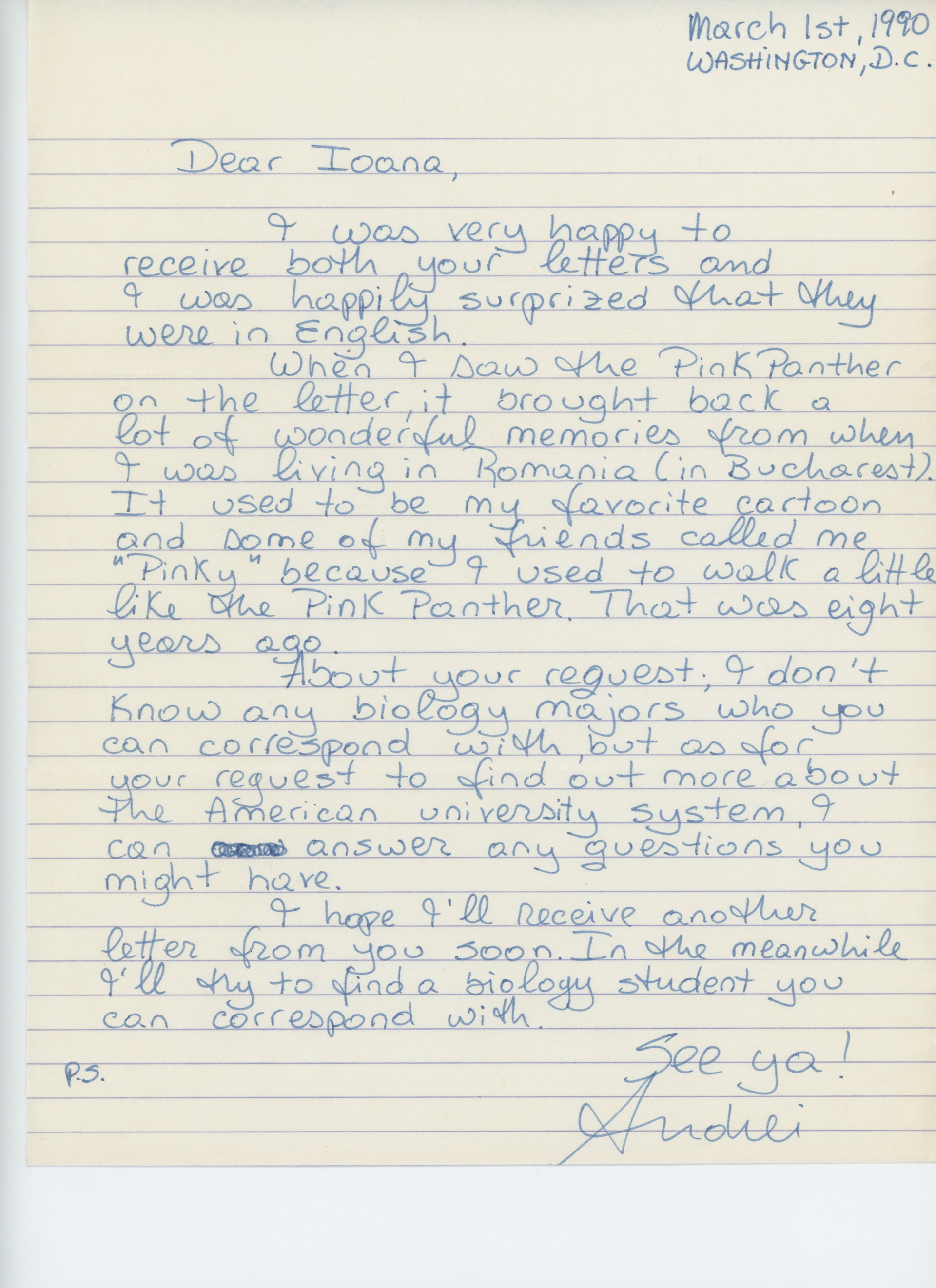
On March 1, 1990, the Valentine’s Day in Romania, Andrei sent Ioana, a biology student, a letter in English in response to Ioana’s letter in English, telling her that the Pink Panther drawing in her letter “stirred memories of my childhood in Romania (Bucharest). Pink Panther was one of my favorite cartoons and my friends nicknamed me “Pinky” because, sometimes, I would walk like Pink Panther. That was eight years ago.”
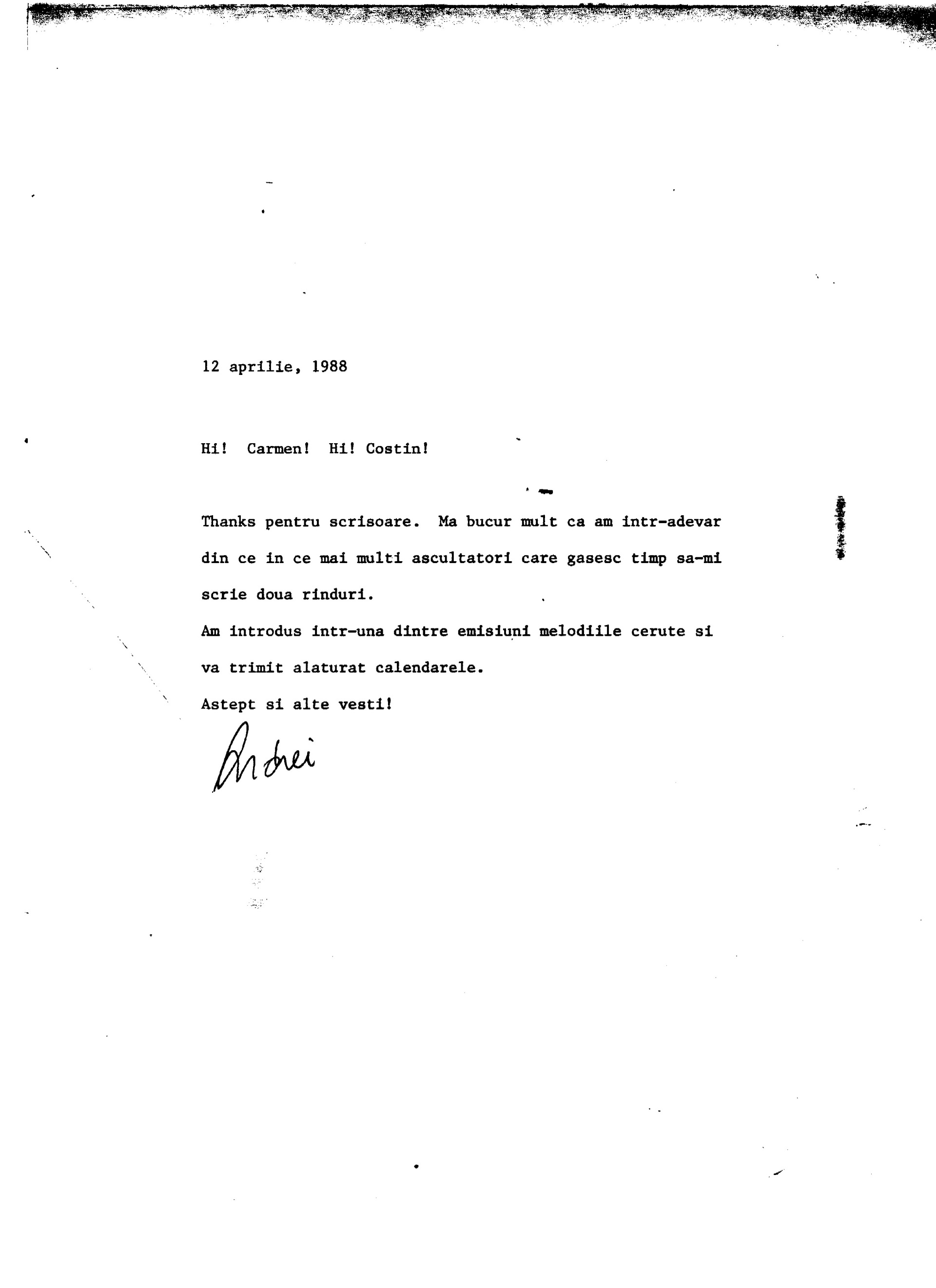
In April 1988, Andrei sent a letter to Carmen and Costin telling them “I’m so glad more and more listeners have been sending me letters. I’ve included your requests in one of my shows, and I’m sending you the calendars with this letter.”
In April 1988, Andrei sent a letter to Carmen and Costin telling them “I’m so glad more and more listeners have been sending me letters. I’ve included your requests in one of my shows, and I’m sending you the calendars with this letter.”
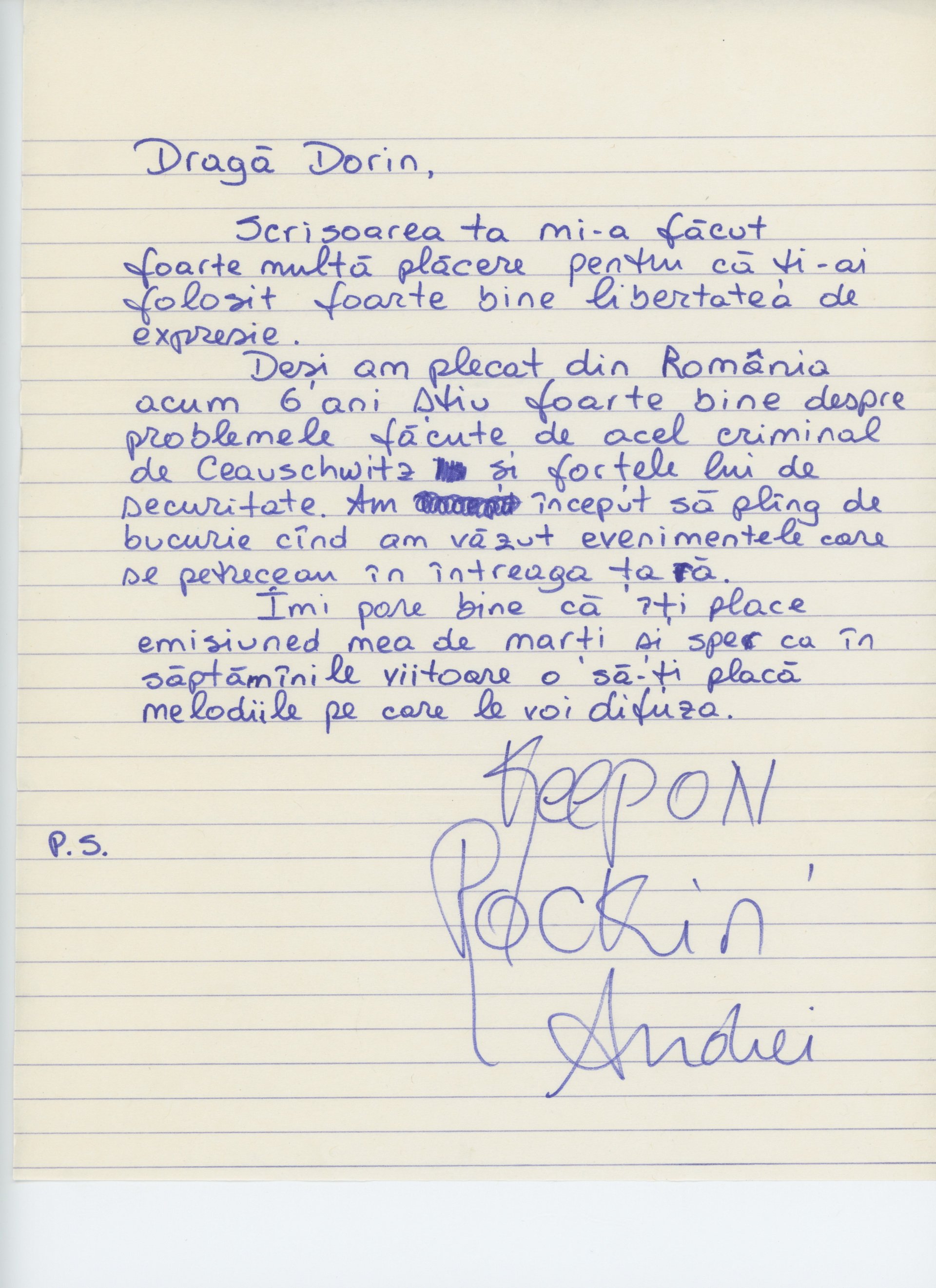
In his response to Dorin, Andrei confessed, “I burst out in tears of joy when I saw the events unfolding all over the country.”
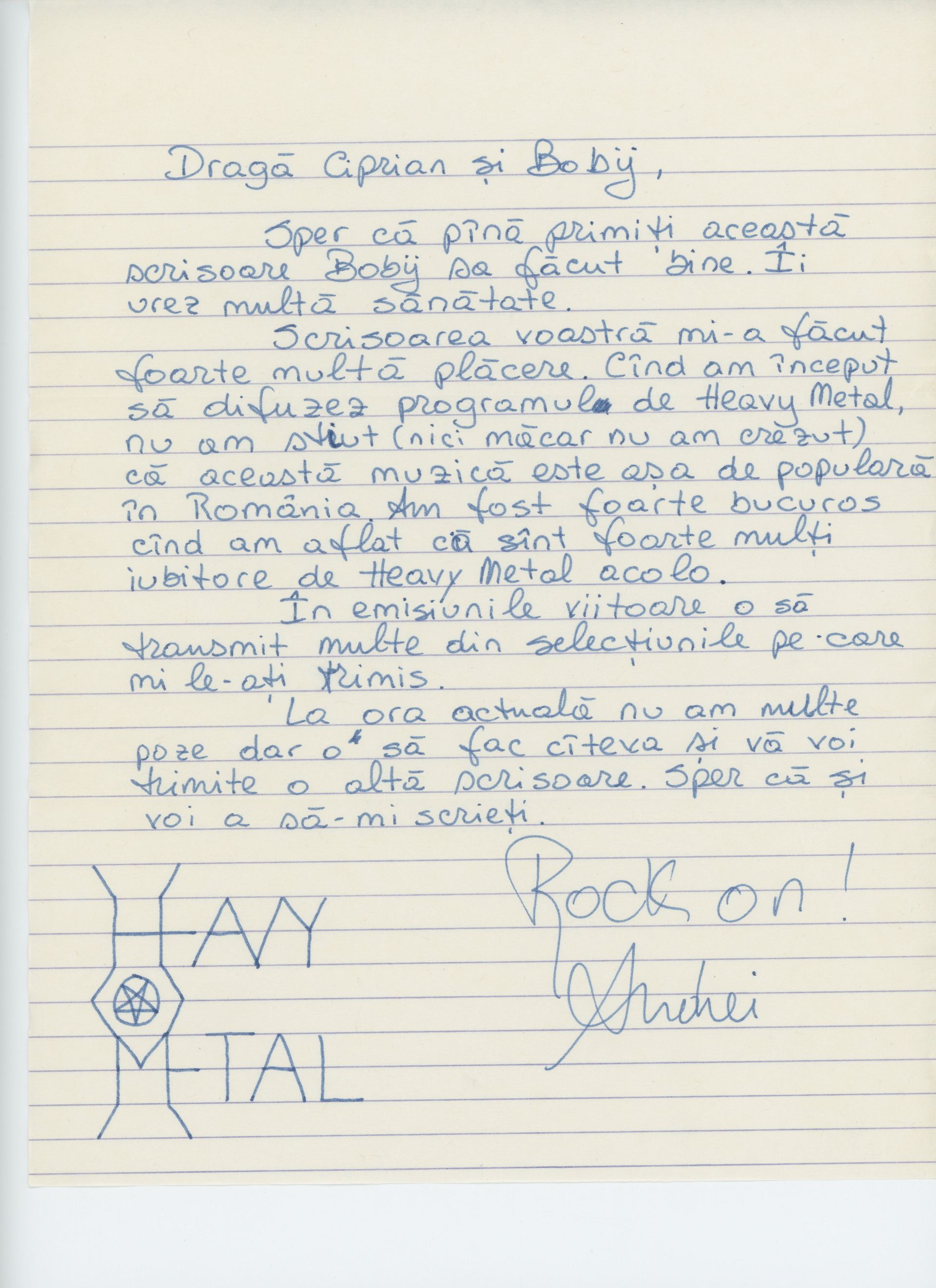
Andrei promised Ciprian and Boby he would broadcast their song requests in the Tuesday shows.
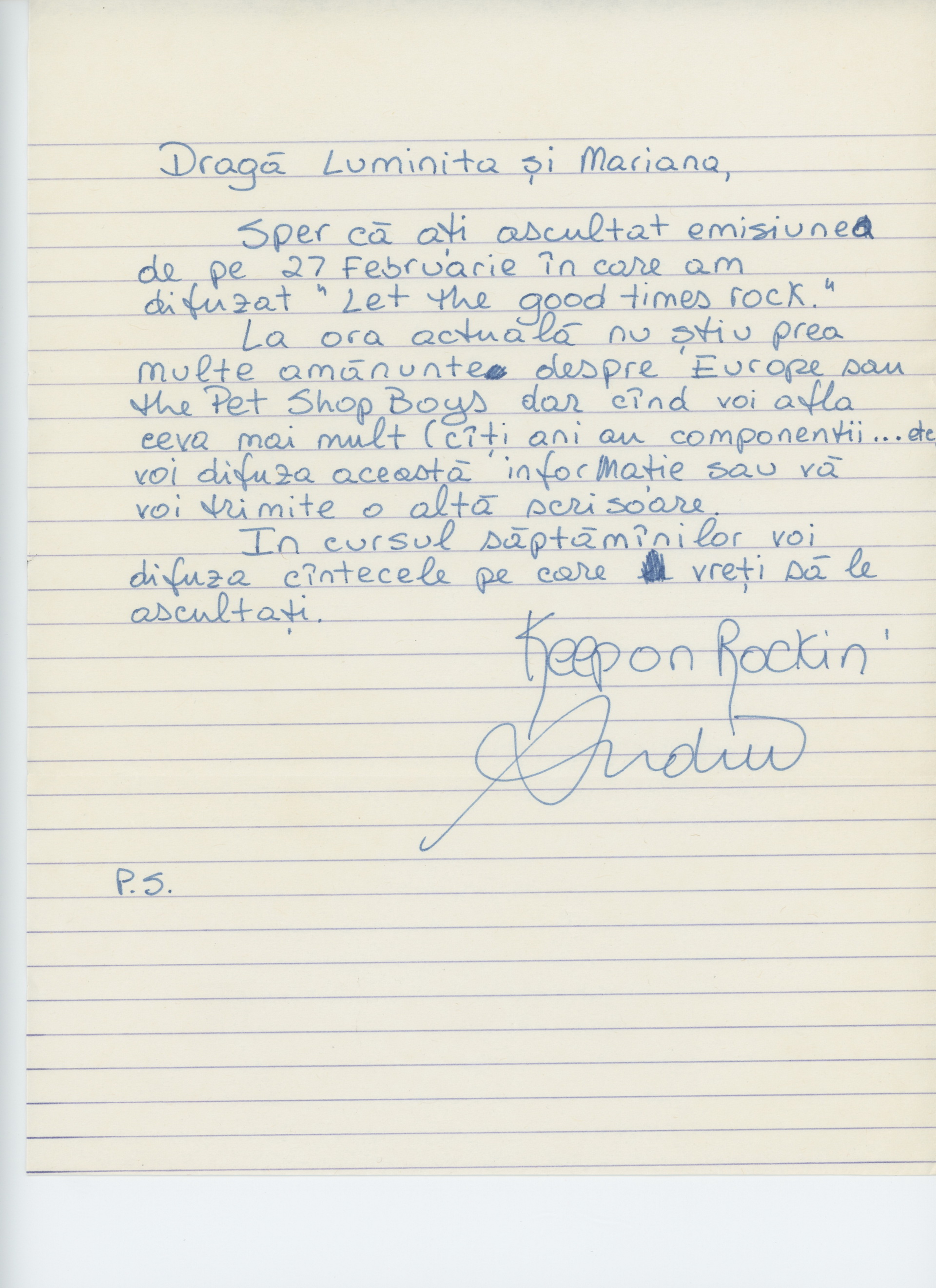
In his response to Luminița and Mariana’s letter, Andrei confirmed he had received their letter and promised the two friends that “although I don’t know too much about Europe and Pet Shop Boys, as soon as I learn more about these bands (how old are the artists, etc.), I’ll broadcast the details or I’ll send you another letter.”
Andrei promised Ciprian and Boby he would broadcast their song requests in the Tuesday shows.
In his response to Luminița and Mariana’s letter, Andrei confirmed he had received their letter and promised the two friends that “although I don’t know too much about Europe and Pet Shop Boys, as soon as I learn more about these bands (how old are the artists, etc.), I’ll broadcast the details or I’ll send you another letter.”
With their unfettered enthusiasm to be Andrei’s pen pals, the young rockers and metalists forged a film-like image of their friend, the teenager DJ with whom they met every Tuesday and who would go to wonderful concerts to interview their favorite artists. Obviously, they did not know that, unlike other western radio stations, VOA’s language services, such as the Romanian Service, did not have dedicated staff for music shows or staff to produce the rock & roll and heavy metal show. Andrei was a VOA intern [working for free] who did the shows by himself, using, of course, the broadcasting equipment and technical assistance of VOA’s facilities.
Click here to return to the In Studio page with information about the Tuesday show, about the contest launched in May 1990, and to read the script of his good-bye show that, because of a bureaucrat’s reckless decision, was never aired.
Click here to return to the In Studio page with information about the Tuesday show, about the contest launched in May 1990, and to read the script of his good-bye show that, because of a bureaucrat’s reckless decision, was never aired.

